Imagine you’re standing in a queue.
From where you’re standing, you can probably see one person in front of you and one person behind you. That’s the entire extent of what’s available to you. You can’t see how long the queue really is. You can’t see whether it’s moving quickly or slowly. You can’t see what’s causing it to slow down or stop, whether people are joining your queue or quietly stepping out of it to join a different one instead, or whether there’s another queue moving faster somewhere behind you.
And yet, almost nobody stands in a queue without forming an opinion about it.
“The person at the front must be taking ages.” “This system is obviously slow.” “This queue never moves.” “The other one’s definitely quicker.”
None of that is actually knowledge. It’s an assumption, built from a view of two people, dressed up as an observation. The interesting part isn’t that we do this. It’s how reasonable the assumption feels while we’re making it.
The only way to understand the whole picture
There’s exactly one way to find out what’s actually happening in that queue, and it isn’t asking the person in front of you to explain it. It’s stepping outside.
From outside, everything changes. Suddenly you can see the beginning and the end. You can see the overall length. You can see who’s joining, and who’s quietly leaving for the queue next to you instead. You can see where the actual bottleneck is, whether there are multiple queues, and which one has genuinely been moving faster the whole time.
Nothing about the queue itself changed. Only your position relative to it did.
Businesses work exactly the same way
Business owners spend every working day inside their business. Customers, emails, meetings, staff, sales, operations, finance, problems, all of it, all the time. Because they’re inside it, they naturally view it from that position. They see the problems immediately in front of them clearly. They remember the things that happened immediately behind them. What they rarely get is the chance to see how it’s all connected.
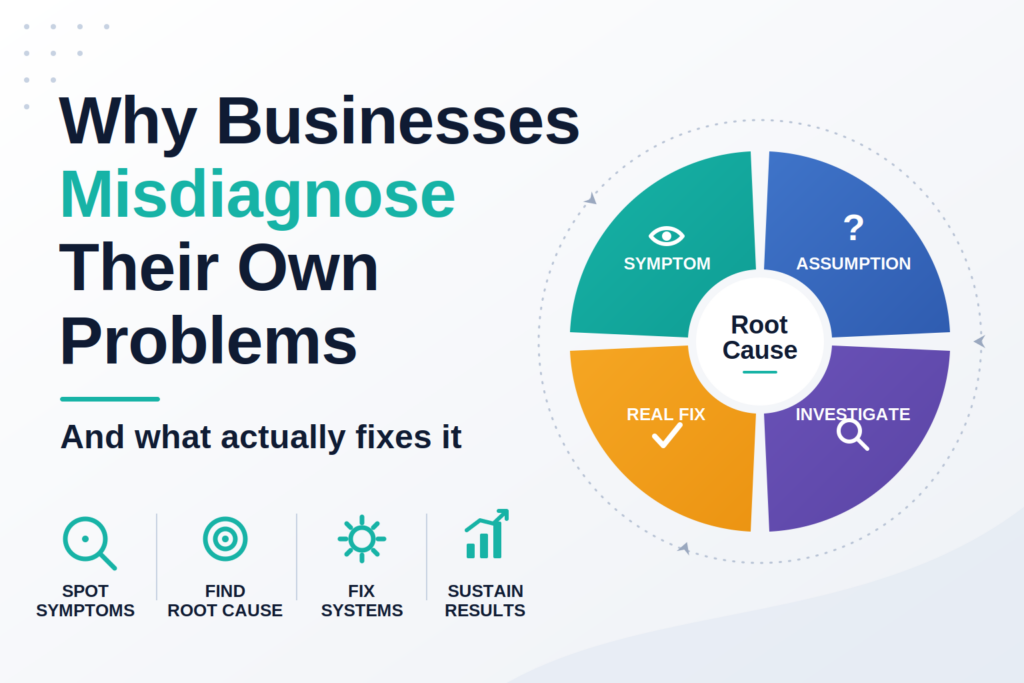
This is why businesses so often misdiagnose their own problems. Standing inside the business, it’s completely natural to believe things like: sales are down because marketing isn’t generating enough leads. Or: customer service is struggling because the CRM isn’t good enough. Or: staff aren’t performing because they need more training.
Sometimes that’s exactly right. Very often it isn’t. Just like the queue, the explanation is built from a limited view, not the whole picture, and it’s worth noticing that the confidence behind the explanation has nothing to do with how accurate it actually is.
Every position creates a different view
Look at the same business from different desks and you get genuinely different pictures. The owner sees one thing. The sales team sees another. Marketing sees something different again. Operations has its own view entirely. Finance sees something else on top of that.
The owner might see falling sales. The sales team might see leads that go cold before they close. Marketing might see enquiries that never turn into leads in the first place. Each of them is seeing something real, just not the same thing, and not necessarily anywhere near what’s actually causing it.
Here’s the part that catches most businesses out: every one of those views is correct. Nobody’s lying, nobody’s wrong about what they’re personally seeing. Each person is accurately reporting the section of the queue visible from where they’re standing. The mistake isn’t in any individual view. It’s in mistaking the symptom you can see for the cause you can’t.
We naturally fill in the gaps
There’s a reason this pattern is so consistent across almost every business, not just disorganised ones. People dislike uncertainty. When we don’t have complete information, the brain doesn’t sit comfortably with “we don’t know.” It fills the gap. It builds an explanation that feels logical and reasonable, sometimes a genuinely persuasive one, even though it was built from a view of one person in front and one behind.
Those explanations often feel completely correct while we’re making them. That’s exactly what makes them worth double checking rather than acting on immediately.
The bigger the business, the harder this becomes
As businesses grow, more people become involved. More systems get introduced. More processes develop. More departments emerge. More handovers happen between all of them.
No single person in a growing business can easily see everything anymore. Each person becomes another individual standing in the queue, seeing only the section immediately around them, filling in their own gaps with their own reasonable-sounding stories. A small business has a short queue and a couple of gaps to fill. A larger one has a long queue, dozens of people, and dozens of slightly different stories being told about the same underlying reality.
That’s not a sign something has gone wrong. It’s simply what happens as an organisation gets bigger. It’s just worth knowing it’s happening, because it changes what kind of problem you’re actually trying to solve.
The value isn’t better answers, it’s better questions
Once you accept that any single view inside the business is necessarily incomplete, the useful move stops being “find the right answer” and starts being “ask a different question.”
Instead of asking “how do we fix sales,” a more useful question is “what’s actually influencing sales.” Instead of “do we need a new CRM,” it becomes “why does our current process produce the results it produces.” One of those chases a symptom. The other starts to understand a system.
That’s a genuinely different way of approaching a problem, and it’s the same shift as stepping outside the queue. Nothing about the business has to change for this to work. Not the people, not the software, not the processes. Only where you’re looking from.
Closing thought
The next time you’re trying to solve a problem inside your own business, it’s worth asking one honest question: are you looking at this from inside the queue, or have you actually stepped outside to see the whole picture?
This is, in a lot of ways, the entire reason our Diagnose stage exists before we discuss a single feature, platform, or piece of software. Standing inside a business every day is exactly what makes it hardest to see clearly from there. Stepping outside, even briefly, and looking at how the whole thing connects together, tends to reveal a different, and usually more accurate, picture of what’s actually going on.
Nothing about your business has to change for that view to become available. Just where you’re looking from.
